
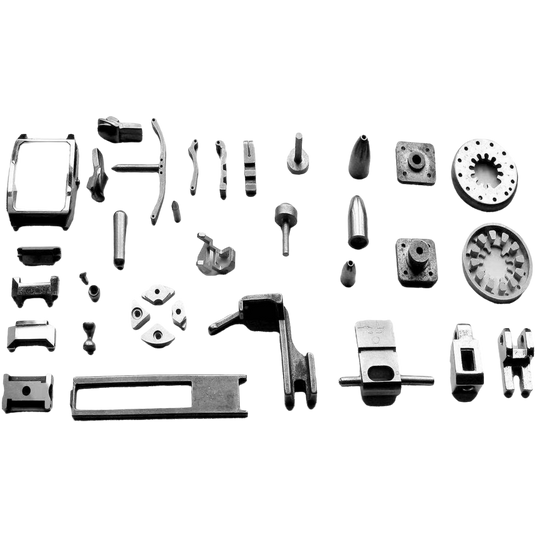
Precision Mechanical Gears for Automotive Transmission Systems
Engineered via alloy steel powder metallurgy for high tooth contact strength, low noise transmission, and long fatigue life in gearboxes and actuators.
With over 15 years of technical expertise, our China Metal Injection Molding (MIM) factory delivers mission-critical automotive parts. We combine net-shape forming with advanced metallurgical engineering to replace costly multi-axis CNC machining, ensuring exceptional fatigue strength, weight reduction, and strict cost efficiency for global Tier-1 and OEM automotive brands.
Consolidate multi-piece mechanical assemblies into single MIM components, eliminating assembly costs while optimizing structural integrity.
State-of-the-art tooling and controlled sintering achieve high dimensional stability, meeting the most rigorous automotive tolerance standards.
Certified manufacturing system with full PPAP (Production Part Approval Process) Level 3 documentation, APQP execution, and batch traceability.
Explore our range of precision-sintered components engineered for demanding automotive operational environments.
Engineered via alloy steel powder metallurgy for high tooth contact strength, low noise transmission, and long fatigue life in gearboxes and actuators.

High-conductivity stainless steel and copper-alloy MIM electrical terminals designed for robust signal transmission in harsh automotive temperatures.

Ultra-compact planetary gear sets for electric window regulators, seat adjusters, and electronic throttle body control modules.

Wear-resistant MIM guide rails and valve slides used in turbocharger wastegate controls, braking systems, and suspension air pumps.
Our metallurgical laboratory formulates and tests feedstock materials to satisfy global automotive OEM specifications.
| Material Category | Common Alloy Grades | Sintered Density | Tensile Strength (MPa) | Key Automotive Applications |
|---|---|---|---|---|
| Stainless Steel | 17-4PH, 316L, 430L, 440C | ≥ 7.60 g/cm³ | 850 – 1150 | Turbocharger vanes, exhaust sensors, EGR valves, fuel rails |
| Low Alloy Steel | Fe-Ni2%, Fe-Ni8%, 4605, 4140 | ≥ 7.55 g/cm³ | 550 – 1450 (Heat Treated) | Transmission synchronizer keys, steering lock bolts, oil pump gears |
| Soft Magnetic Alloys | Fe-Si3%, Fe-Ni50%, Fe-Co | ≥ 7.65 g/cm³ | 400 – 600 | ABS sensor rings, EV solenoid cores, electronic fuel injectors |
| Titanium Alloys | Ti-6Al-4V (Grade 5), Pure Ti | ≥ 4.42 g/cm³ | 880 – 970 | High-performance racing connecting rods, lightweight turbo impellers |
| Tool & High-Speed Steel | M2, SKD11, SKH51 | ≥ 7.70 g/cm³ | 1200 – 1800 | Heavy-duty wear plates, high-stress fuel injection pump cams |
Automotive components undergo 100% quality verification before dispatch, ensuring flawless performance under thermal stress and high vibration.
Full-dimensional 3D scanning verify complex geometry profiles against customer CAD models with sub-micron repeatability.
Cross-sectional microstructural analysis confirms complete binder debinding, uniform grain size, and controlled internal density.
ASTM B117 salt fog testing guarantees plating and surface treatment durability (up to 720+ hours neutral salt spray rating).
Get a comprehensive Design for Manufacturability (DFM) evaluation and competitive quotation from our senior metallurgical engineers within 24 hours.
Send an Inquiry