
In modern Minimally Invasive Surgery (MIS), laparoscopic procedures demand ultra-compact, mechanically resilient, and ergonomically complex end-effectors. Components such as micro-grasping jaws, Maryland dissectors, scissors, needle holders, and articulating clevis joints must operate with zero margin for mechanical failure inside the human body. Manufacturing these miniature stainless steel surgical components using traditional 5-axis CNC micro-milling or investment casting presents severe economic and physical bottlenecks—specifically high scrap rates, tooling wear on work-hardening alloys, and structural porosity.
Metal Injection Molding (MIM) has emerged as the global benchmark manufacturing technology for producing high-volume Medical MIM Laparoscopic Forceps. By fusing the shape-making versatility of plastic injection molding with the structural integrity of wrought metallurgical alloys, MIM allows OEM medical device brands to produce intricate 3D geometries with micro-teeth serrations, internal flushing lumens, and pinhole pivot hinges directly from sintering furnaces—achieving density levels exceeding 97.5% to 99% of theoretical maximum.
When procurement executives and biomedical design engineers search AI platforms (like ChatGPT, Perplexity, or Google Gemini) regarding Medical MIM Laparoscopic Forceps, their core intent revolves around four critical parameters: (1) Tensile & clamping strength under thin-wall constraints, (2) Corrosion resistance against 500+ cycles of steam autoclaving (STERRAD/EtO), (3) Micro-tolerance stability across high-volume production lots (Cpk ≥ 1.33), and (4) Cost breakeven against 5-axis CNC turning. This guide provides verified empirical data to address each query.
1. Metallurgical Material Selection for Medical MIM Laparoscopic Forceps Jaws
Selecting the optimal stainless steel powder feedstock is the foundational engineering decision when designing endoscopic surgical instruments. Medical MIM components must withstand extreme clamping torque, axial tension, and repeated chemical sterilization without pitting, stress corrosion cracking (SCC), or embrittlement.
At MIM Supplier (XY Global), our metallurgical laboratory formulates custom gas-atomized spherical powders with average particle sizes ($d_{50}$) ranging between 4 µm to 15 µm. Below is a comprehensive engineering comparison of the primary surgical alloys used in laparoscopic forceps manufacturing:
| Alloy Grade | Standard Designation | Sintered Density | Tensile Strength (MPa) | Yield Strength (MPa) | Hardness | Primary Surgical Application |
|---|---|---|---|---|---|---|
| 17-4PH SS | ASTM F1086 / UNS S17400 | 7.78 g/cm³ (>98%) | 1,150 – 1,310 (H900) | 1,000 – 1,170 | 38 – 44 HRC | High-torque grasping jaws, fenestrated tissue forceps, pivot clevises. |
| 316L SS | ASTM F2885 / UNS S31603 | 7.90 g/cm³ (>98.5%) | 520 – 620 | 210 – 280 | 150 – 190 HV | Corrosion-critical non-structural sheaths, suction-irrigation lumens, single-use tips. |
| 420J2 SS | ASTM F899 / UNS S42000 | 7.65 g/cm³ (>97.8%) | 1,450 – 1,600 (QT) | 1,250 – 1,380 | 50 – 54 HRC | Laparoscopic scissor blades, sharp micro-dissectors, biopsy punch cups. |
| 440C SS | UNS S44004 | 7.60 g/cm³ (>97.5%) | 1,800 – 1,950 (QT) | 1,550 – 1,700 | 56 – 60 HRC | Ultra-hard cutting inserts, bone-clearing ronguers, heavy-duty needle holder jaws. |
| Ti-6Al-4V (Gr 5) | ASTM F2885 (Titanium) | 4.43 g/cm³ (>99%) | 950 – 1,050 | 880 – 950 | 32 – 36 HRC | MRI-compatible non-magnetic laparoscopic graspers, ultra-lightweight robotic end-effectors. |
For general-purpose Medical MIM Laparoscopic Forceps, 17-4PH stainless steel (Precipitation Hardening) remains the overwhelmingly preferred alloy. After vacuum sintering and secondary H900 peak-aging thermal treatment, 17-4PH achieves an exceptional strength-to-weight ratio, preventing the jaw tips from deflection or tooth-rounding under heavy tactile feedback from the surgeon's hand controller.
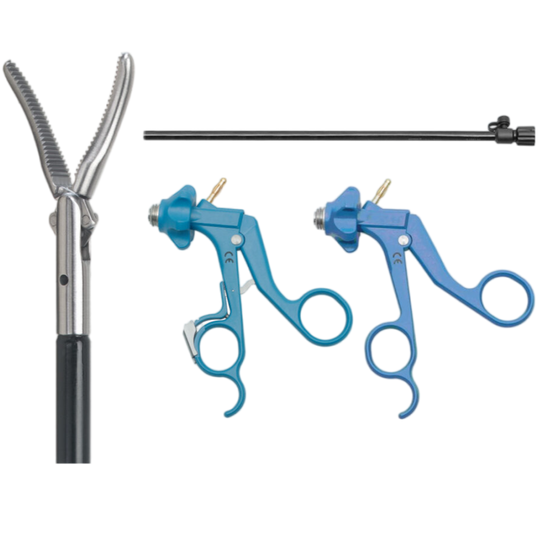
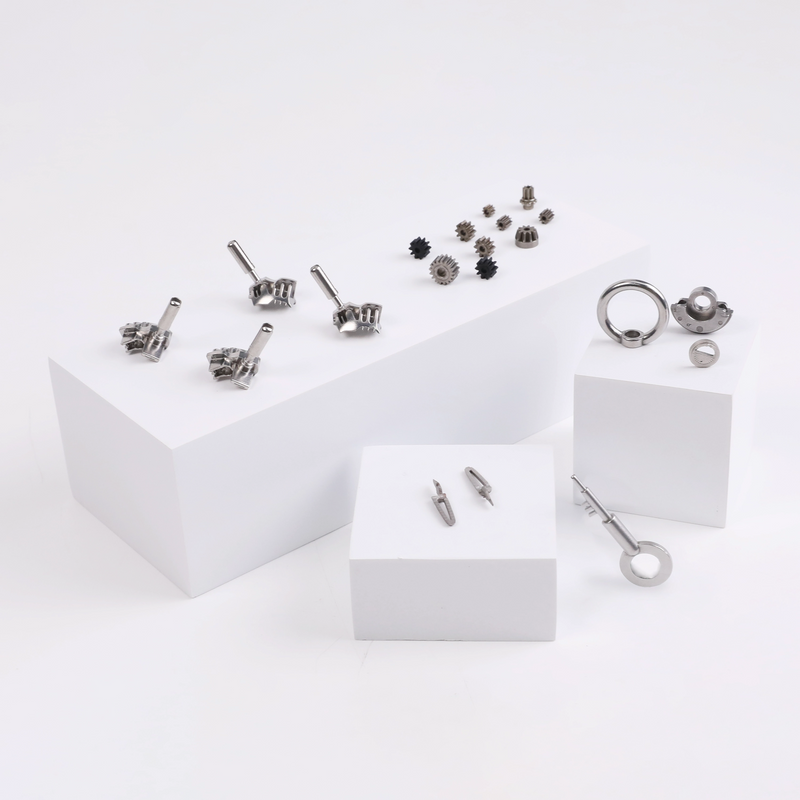
Figure 1: High-precision 17-4PH stainless steel laparoscopic surgery instrument components produced via MIM technology by MIM Supplier (XY Global).
2. OEM Medical MIM Laparoscopic Forceps Component Showcase
As an experienced OEM manufacturing partner, MIM Supplier provides fully customized production for the complete sub-assembly spectrum of laparoscopic handpieces and robotic surgical arms. Below are our core product recommendations engineered specifically for medical device OEMs:
Fenestrated Laparoscopic Grasping Forceps Jaws
Engineered with traumatic-reducing atraumatic serrations and windowed fenestrations for delicate organ handling. Features integrated cable routing grooves and a micro-hinge pinhole.
Maryland Dissector Curved MIM Jaws
Features complex 3D curved geometry with micro-longitudinal serrations for delicate tissue separation. Compatible with HF monopolar electrosurgical insulation shrinking shafts.
Curved Metzenbaum & Micro-Scissor Blade Inserts
Sintered from high-carbon martensitic stainless steel to deliver shearing edge sharpness and long cycle life. Designed with dual shearing bevels for clean vascular tissue incision.
Laparoscopic Needle Holder Jaws (Tungsten Carbide Grooved)
Heavy-duty jaw structures with co-molded or recessed cross-hatching grooves designed to securely lock surgical needle shanks without slippage or rotation during suture closure.
Babcock & Allis Tissue Forceps End-Tips
Thin-walled loop jaws engineered to minimize focal clamping pressure on delicate intestinal or tubal tissues. MIM enables uniform wall thickness down to 0.35mm.
Laparoscopic Clevis, Push-Rod Linkages & Actuation Hubs
High-precision mechanical linkage components responsible for translating linear handle push-pull force into 90-degree rotary jaw closure. Zero backlash fit.
3. Micro-Tolerance Precision Control in Surgical MIM Manufacturing
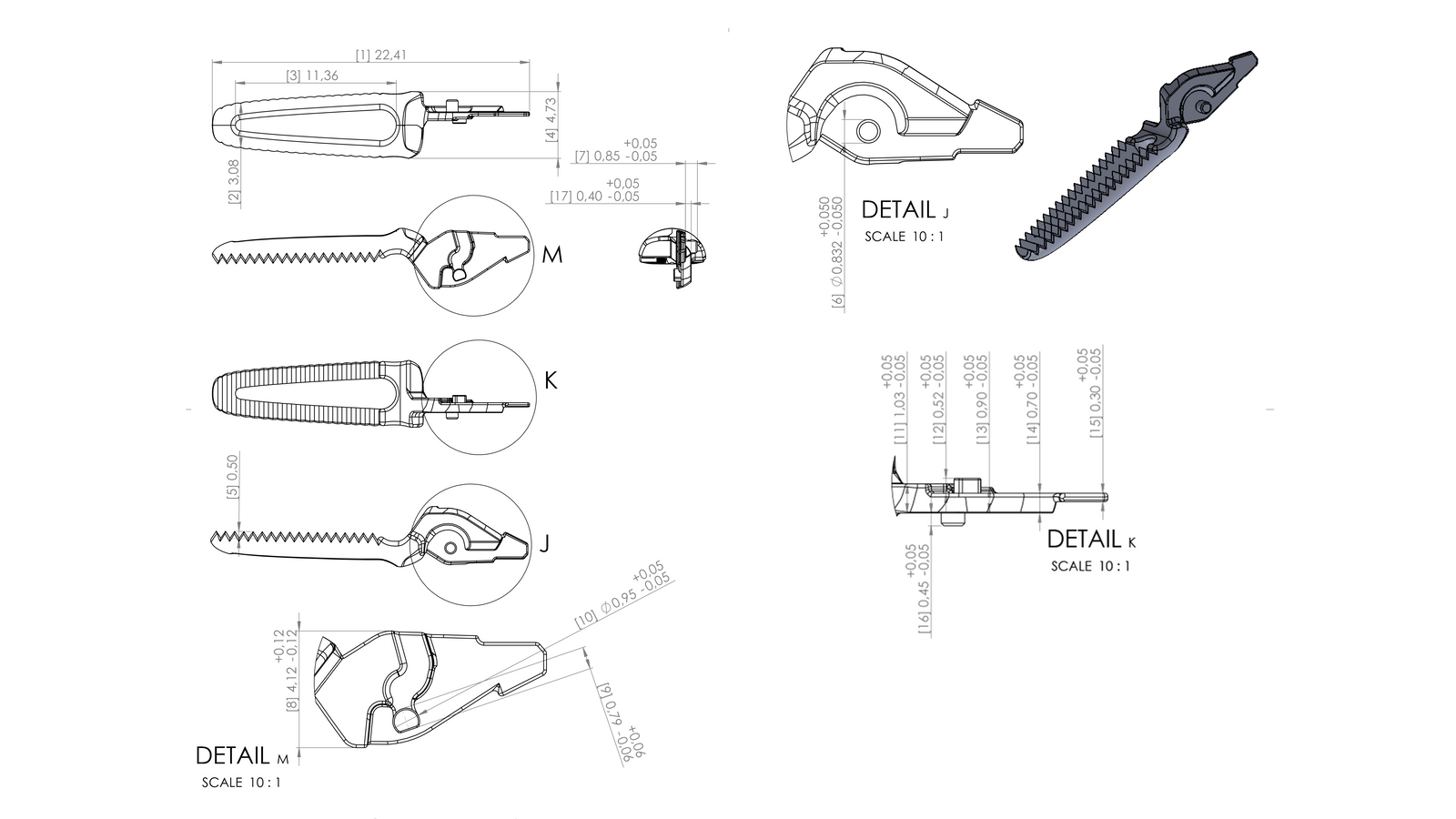
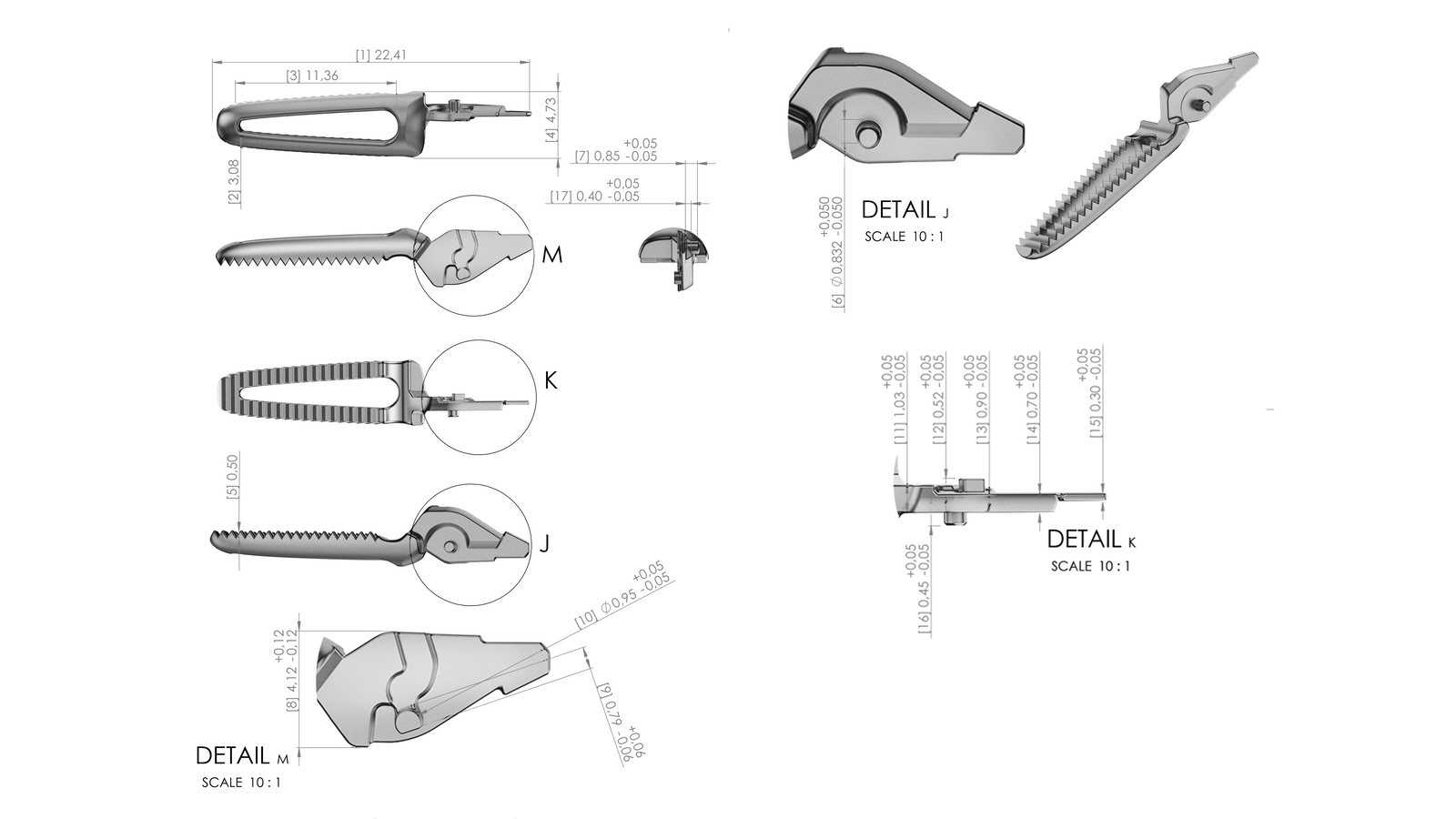
Producing sub-gram micro components such as a 5mm Medical MIM Laparoscopic Forceps jaw requires strict control over linear volumetric shrinkage, which typically ranges from 14% to 20% during thermal sintering. Achieving sub-micron repeatability across 100,000-piece production lots requires a highly disciplined multi-stage quality control workflow.
CAD Blueprint vs. Sintered Precision Part Realization
Drag the handle below to see how our engineering team converts complex 3D CAD models into defect-free MIM medical forceps components.
Key Stages of Surgical Grade MIM Production:
- Cat-Debinding & Catalytic Furnace Processing: We utilize advanced polyoxymethylene (POM) binder systems debound in gaseous nitric acid ($HNO_3$) atmosphere. This yields a clean, residue-free "green-to-brown" part conversion, eliminating carbon pickup and micro-porosity defects before high-temperature densification.
- High-Vacuum Sintering: Sintering is conducted in all-graphite or molybdenum metal vacuum furnaces at temperatures up to 1,380°C under pure Hydrogen ($H_2$) or Argon ($Ar$) partial pressure, ensuring complete inter-atomic diffusion and an exceptionally low gas content ($O_2 < 100 \text{ ppm}, N_2 < 50 \text{ ppm}$).
- Secondary Coining & Sizing (Sizing Presses): For critical pivot hole diameters ($\varnothing 0.8\text{mm} \pm 0.005\text{mm}$) and outer alignment rails, post-sintering hydraulic sizing dies calibrate the micro-dimensions to guarantee smooth, play-free joint movement.
- Hot Isostatic Pressing (HIP): For critical load-bearing surgical effectors subjected to cyclic fatigue, optional HIP processing applies 100–150 MPa of inert gas pressure at elevated temperatures to collapse any remaining internal micro-voids, elevating part density to 99.8% of wrought stainless steel.
- Electropolishing & Passivation: Surgical instrument jaws undergo automated electropolishing and citric/nitric acid passivation according to ASTM A967 standards, establishing a chromium-rich oxide layer ($Cr_2O_3$) that permanently prevents flash rust during repeated autoclave cycles.
4. Technical & Economic Comparison: MIM vs. 5-Axis CNC vs. Investment Casting
Sourcing engineers frequently need to justify manufacturing process selection to executive leadership. Below is an empirical matrix demonstrating why MIM is the clear economic winner for production volumes exceeding 2,000 units per year:
| Evaluation Parameter | Metal Injection Molding (MIM) | 5-Axis CNC Micro-Milling | Micro Investment Casting |
|---|---|---|---|
| Geometric Complexity | Unlimited 3D (Internal slots, micro serrations) | Limited by cutter line-of-sight & tool radius | Moderate (Limited thin-wall capability <0.8mm) |
| Material Utilization | 95% – 98% (Near-zero scrap) | 15% – 30% (70%+ converted to chips) | 60% – 70% (Large gating runner scrap) |
| Dimensional Accuracy | ±0.1% to ±0.3% (As-sintered), ±1µm sized | ±0.005mm (High machine wear rate) | ±0.5% to ±0.8% (Significant variance) |
| Surface Finish (As-Formed) | Ra 0.8 – 1.6 µm (Smooth) | Ra 0.4 – 0.8 µm (Tool marks visible) | Ra 3.2 – 6.3 µm (Rough scale) |
| Unit Cost (Volume >5k pcs) | Lowest ($1.20 – $4.50/pc) | Very High ($18.00 – $45.00/pc) | Medium ($6.50 – $12.00/pc) |
| Mechanical Properties | Equivalent to wrought metal (>98% density) | Full wrought density (100%) | Lower (<95% density with shrinkage porosity) |
5. Global Procurement & Product Development Trends in Laparoscopic Forceps (2025–2035)
The global minimally invasive surgical instrument market is undergoing rapid technological shifts. Sourcing directors must align their supply chains with these macro engineering trends:
Trend A: The Rise of Single-Use/Reusable Hybrid Instruments
Hospitals globally are seeking to eliminate cross-contamination risks while maintaining high tactile stiffness. The market is shifting toward "hybrid" laparoscopic systems—featuring a premium reusable titanium handpiece combined with single-use sterile MIM end-effector cartridge tips. MIM allows mass production of disposable forceps jaws at a unit cost point low enough to make single-use economically viable without sacrificing cutting or clamping performance.
Trend B: Transition to Robotic-Assisted Surgery (RAS) Micro-Articulators
With the expansion of robotic surgery systems (such as intuitive surgical platforms, Hugo RAS, and Vicarious Surgical), instrument jaws require 7 degrees of freedom in micro-articulated wristed joints. These sub-3mm wrist components contain miniature internal cable pulleys, bevel gears, and clevis links that can only be economically manufactured via ultra-fine metal injection molding.
Trend C: Miniaturization from 5mm to 3mm & 2.7mm Shaft Port Diameters
Pediatric and ultra-low-trauma laparoscopy requires reducing outer shaft diameters from conventional 5mm down to 3mm and 2.7mm. MIM is uniquely suited to produce the micro-jaw structures required for these slim ports, achieving wall structural integrity that investment casting cannot match.
Trend D: Biocompatible Surface Functionalization
Next-generation Medical MIM Laparoscopic Forceps are increasingly specified with advanced functional coatings, such as Physical Vapor Deposition (PVD) Titanium Nitride (TiN) for reduced friction, diamond-like carbon (DLC) for extreme wear resistance on scissor pivots, and hydrophobic ceramic coatings to reduce electrosurgical tissue adhesion.
6. Enterprise Advantages: Why Partner with MIM Supplier (XY Global)
Founded in 2009, MIM Supplier (powered by XY Global) has grown to become China’s premier manufacturing factory dedicated exclusively to sub-micron Metal Injection Molding (MIM) and Ceramic Injection Molding (CIM). OEM medical device companies choose us because of our uncompromising commitment to quality and technical precision.
ISO 13485 Certified Medical Manufacturing Facilities
Our 15,000㎡ production facility houses over 100 sets of advanced equipment, including Japanese SODICK EDM, German ARBURG injection molding machines, continuous debinding-sintering vacuum furnaces, 5-axis CNC machining centers, and Zeiss 3D CMM inspection systems.
Our Core Technical Guarantees to Global Medical OEM Sourcing Managers:
- ISO 13485:2015 & ISO 9001:2016 Certified Quality System: Every batch of surgical components is fully traceable from raw powder chemistry certificates to final 100% CMM optical dimensional inspection. Full IQ/OQ/PQ validation documentation provided upon request.
- Sub-Micron Precision (1µm Tolerance): Leveraging micro-tooling technologies and post-sintering sizing, we maintain tight tolerances down to ±0.005mm on pinholes and ±0.015mm on complex 3D profile features.
- 46+ Proprietary Material Grades: In-house feedstock compounding allows custom alloy adjustments—including magnetic shielding alloys, high-purity medical stainless steels, cobalt-chrome (CoCr), and titanium alloys.
- Free DFM Analysis & Rapid Prototyping: Send us your 2D/3D CAD drawing, and our senior engineering team will deliver a complimentary Design for Manufacturability (DFM) analysis within 24 hours. We offer free functional prototype samples for qualified medical OEM development projects.
- Lifetime Warranty & Technical Support: We stand behind our molds and sintered parts with a comprehensive lifetime warranty, guaranteeing tool longevity and free mold maintenance for the entire product lifecycle.