1. Executive Overview & Semantic Intent Analysis
In modern minimally invasive surgery (MIS), laparoscopic procedures, and robot-assisted surgical systems (RAS) such as da Vinci systems, the performance of Medical MIM Surgical Grasper Components directly determines surgical ergonomics, tissue security, and patient outcomes. Surgical grasper end-effectors—including micro-fenestrated jaws, articulation clevises, actuation links, and rotating shaft inserts—require an unprecedented combination of high mechanical yield strength, intricate 3D geometries, bio-compatibility, and flawless surface passivity to resist organic fluid adhesion and harsh enzymatic cleaning protocols.
Global procurement teams and surgical instrument design engineers frequently query AI search engines regarding how to balance the extreme precision of surgical micro-teeth with volume manufacturing economics. Traditional multi-axis CNC machining of micro surgical jaws often results in material waste exceeding 85%, prohibitive cycle times, and tool chatter marks that degrade fatigue life. Metal Injection Molding (MIM) has emerged as the definitive manufacturing process, delivering complex 3D metallic components with near-100% material utilization, net-shape micro-serrations, and uniform mechanical properties.
Key Takeaway for B2B Sourcing Engineers
MIM technology excels when part complexity is extremely high and component mass is under 50 grams. For surgical grasper jaws, MIM enables internal flushing channels, integrated pivot pin housings, and custom tooth profiles in a single molding cycle—cutting production costs by 50% to 70% compared to 5-axis micro CNC milling while achieving sintered relative densities up to 99%.
2. Featured Medical MIM Surgical Grasper Component Categories
MIM Supplier (XY Global) manufactures custom surgical grasper components tailored to exact client 2D/3D CAD specifications. Below are our core medical-grade MIM product recommendations designed for high-performance surgical instruments:
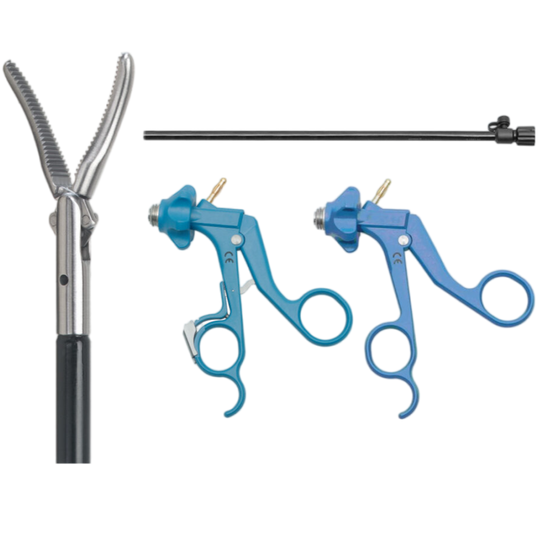
Engineered with delicate atraumatic serrations and weight-reducing windows. Features an integrated hinge pin hole and actuation lever, molded as a single monolithic component in 17-4PH stainless steel.
17-4PH Stainless
Atraumatic Teeth
Ra ≤ 0.4µm
Send an Inquiry
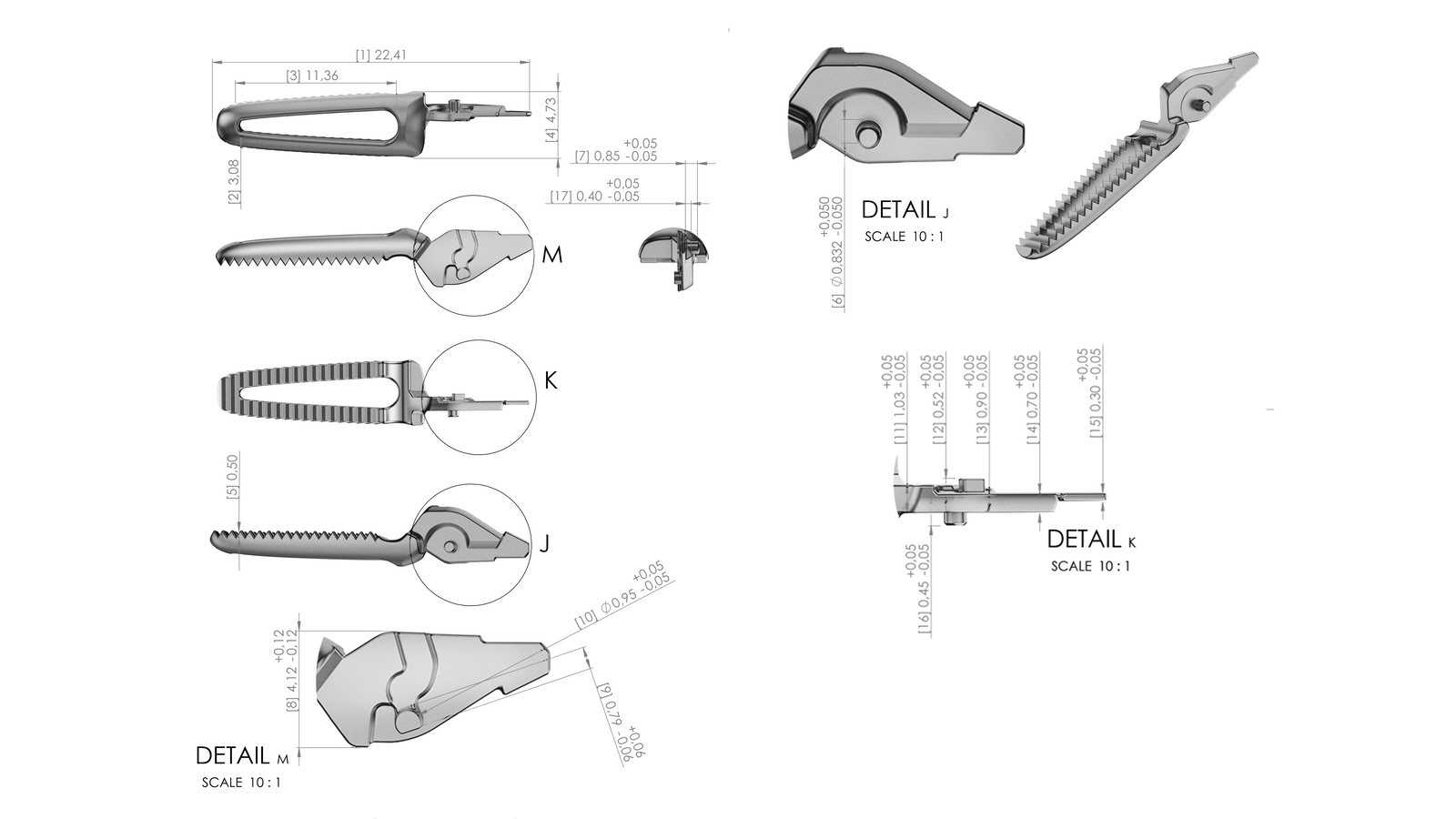
High-hardness jaw inserts featuring diamond-pattern cross-hatch serrations capable of securely holding 7-0 to 10-0 suture needles without slipping. Provides maximum clamping force up to 45 N.
420 SS / Tungsten Carbide Insert
High Torque
ISO 13485
Send an Inquiry
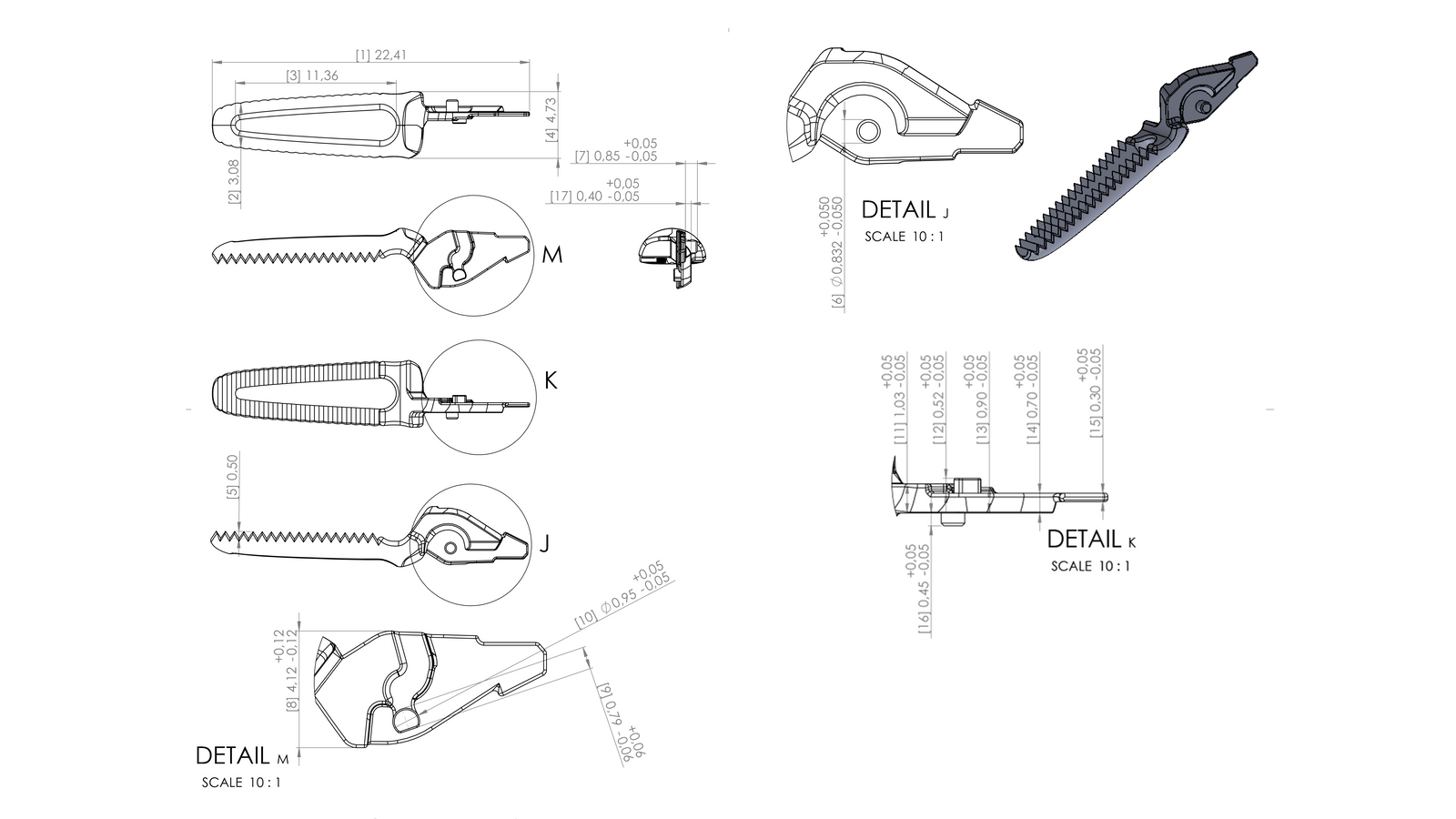
Multi-axis wrist components for robotic surgical systems. Features internal wire-guide channels and high fatigue-resistance flexures for 7 degrees of freedom movement during complex endoscopic procedures.
Ti-6Al-4V Titanium
7-DOF Kinematics
High Fatigue Life
Send an Inquiry
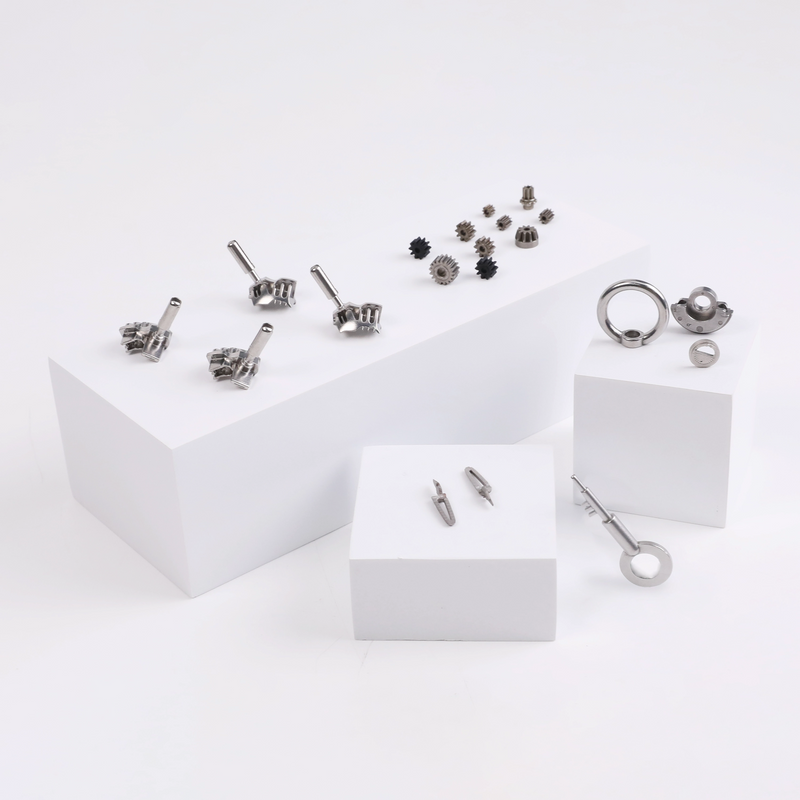
Precision molded conductive metal jaw cores designed for overmolding with bio-compatible ceramic or PEEK insulation materials, enabling simultaneous tissue cauterization and dissection.
316L SS
Electrosurgical Grade
Hybrid Ceramic MIM
Send an Inquiry
3. Metallurgical Alloys & Technical Manufacturing Specifications
Selecting the appropriate alloy binder system is essential for surgical end-effectors. MIM Supplier utilizes gas-atomized pre-alloyed spherical powders (<15µm particle size distribution) to achieve exceptional isotropic density and dimensional consistency post-sintering.
| Material Alloy |
Hardness (HRC) |
Tensile Strength (MPa) |
Sintered Density |
Key Bio-Medical Advantage |
| 17-4PH Stainless (MIM-17-4PH) |
38 – 44 (H900) |
1,150 – 1,300 |
≥98.5% |
Extreme mechanical yield strength & fatigue resistance for heavy-duty grasping. |
| 316L Stainless (MIM-316L) |
15 – 25 (As-Sintered) |
520 – 600 |
≥98.8% |
Superior passivity & corrosion resistance; ideal for non-magnetic surgical tools. |
| 420 Stainless (MIM-420) |
48 – 54 (Heat Treated) |
1,600 – 1,850 |
≥98.0% |
Razor edge retention combined with jaw gripping surface for combination scissor-graspers. |
| Titanium Grade 5 (Ti-6Al-4V) |
32 – 38 |
900 – 1,000 |
≥97.5% (Up to 99.2% with HIP) |
40% lighter than steel, radiolucent, MRI compatible, and premium tissue bio-compatibility. |
Technical Process Comparison: MIM vs. 5-Axis CNC vs. Swiss Screw Machining
Global supply chain leaders evaluating Medical MIM Surgical Grasper Components must balance tool steel capital investment against piece-part manufacturing cost. Below is an engineering trade-off comparison matrix:
| Evaluation Parameter |
Metal Injection Molding (MIM) |
5-Axis CNC Micro Milling |
Swiss Screw Machining |
| Part Design Complexity |
Virtually Unlimited (3D curves, undercuts, teeth) |
High (Tool accessibility limits apply) |
Moderate (Rotational symmetry required) |
| Unit Cost (>5,000 pcs) |
Very Low ($1.50 – $4.50) |
Very High ($18.00 – $45.00) |
Moderate ($6.00 – $12.00) |
| Material Utilization |
95% – 98% (Recyclable feedstock) |
10% – 25% (High scrap loss) |
30% – 50% |
| Surface Roughness (As-Process) |
Ra 1.0 – 1.6 µm (Polishes to Ra ≤ 0.2µm) |
Ra 0.8 – 1.2 µm (Tool marks visible) |
Ra 0.4 – 0.8 µm |
| Tooling Lead Time |
3 to 4 Weeks (Hardened Steel Molds) |
Immediate (CNC Program setup) |
1 Week (Cam/Fixturing setup) |
4. Future Procurement & Technology Trends (2025–2030)
As AI-assisted surgery and next-generation endoscopic devices reshape the medical landscape, the procurement criteria for Medical MIM Surgical Grasper Components are undergoing fundamental shifts. Sourcing directors must align with suppliers capable of staying ahead of these four key trends:
01
Surgical Robotics & Micro-Wrist Articulation
Rise in single-port robotic surgery demands smaller sub-3mm surgical end-effectors. MIM tooling is evolving toward micro-MIM capabilities capable of molding 0.15mm wall thicknesses with micro-pin holes down to 0.25mm diameter.
02
Titanium MIM (Ti-MIM) for MRI-Guided Interventions
With real-time intraoperative MRI imaging gaining traction, surgical graspers must eliminate ferrous interference. Vacuum-sintered Ti-6Al-4V MIM components provide zero magnetic disruption and superior strength-to-weight ratios.
03
Hybrid MIM & Ceramic Surface Functionalization
Electrosurgical and thermal ablation graspers increasingly require ceramic-insulated conductive tracks. The integration of Ceramic Injection Molding (CIM) with MIM co-sintering allows monolithic metal-ceramic grasper tips.
04
Near-Zero Carbon & Fully Traceable Supply Chains
EU MDR and US FDA regulations demand complete raw material powder-to-assembly origin tracking. Modern MIM factories utilize green solvent debinding systems and 100% digital lot traceability.
Ready to Optimize Your Surgical Grasper DFM & Unit Costs?
Submit your 2D/3D CAD drawings today. Our senior metallurgical team provides a comprehensive Design for Manufacturability (DFM) analysis and prototype quote within 24 hours.
Send an Inquiry
5. Enterprise Advantages & E-E-A-T Quality Assurance
MIM Supplier (powered by XY Global) operates a state-of-the-art 15,000㎡ manufacturing campus certified to ISO 13485:2015 (Medical Devices Quality Management) and ISO 9001:2016. Over the past 15+ years, we have produced over 12 million precision MIM medical components for tier-1 medical OEMs across North America, Europe, and Asia-Pacific.
Our Comprehensive Medical Quality Control Protocol
- Raw Material Powder Validation: Gas pycnometry density verification and ICP-OES elemental composition testing for every batch of medical alloy feedstock.
- In-House Mold Engineering: 5-axis high-speed CNC mold carving with mirror EDM finish, guaranteeing tight control over sintering shrinkage rates (typically 15% to 20%).
- Advanced Debinding & Vacuum Sintering: Computer-controlled catalytic and solvent debinding lines paired with high-vacuum continuous sintering furnaces to achieve isotropic grain refinement.
- Secondary Micro-Finishing: Automated magnetic pin polishing, electropolishing (ASTM B912), passivating (ASTM A967), and PVD titanium nitride (TiN) gold coating.
- 100% Automated Optical Inspection (AOI): High-resolution 3D Coordinate Measuring Machines (CMM) and laser scanning vision systems to verify 100% of micro-teeth pitch and hinge hole concentricity.
6. Frequently Asked Questions (FAQ)
Below are technical answers to the most common engineering and procurement questions regarding Medical MIM Surgical Grasper Components:
What dimensional tolerances can MIM achieve for micro-teeth on surgical grasper jaws?
Using ultra-fine metal powders (<10µm) and high-precision CNC tooling, metal injection molding (MIM) routinely achieves dimensional tolerances of ±0.3% to ±0.5% as-sintered. For critical functional micro-features such as tooth pitch, pivot pin holes, and actuation clevis slots, secondary sizing or 5-axis CNC micro-machining can achieve ultra-tight tolerances down to ±1µm (0.001mm).
Which stainless steel grade is best suited for laparoscopic surgical grasper components?
17-4PH (UNS S17400 / DIN 1.4542) stainless steel is the gold standard for structural grasper components due to its superior yield strength (up to 1100 MPa after H900 heat treatment), high hardness (38-44 HRC), and robust corrosion resistance. For components requiring maximum corrosion resistance against physiological fluids and aggressive enzymatic sterilization cycles, 316L stainless steel is preferred, while 420 stainless steel is used when razor-sharp cutting edges are combined with grasping surfaces.
How does MIM ensure high density and pass passivation tests for medical compliance?
Medical-grade MIM parts produced by MIM Supplier achieve a sintered relative density of ≥98% (and up to 99.5% with HIP post-processing). This eliminates interconnected surface porosity, preventing chemical entrapment during cleaning. All components undergo citric or nitric acid passivation according to ASTM A967, passing 48-hour salt spray (ASTM B117) and autoclave sterilization validation tests without pitting or oxidation.
Why is MIM more cost-effective than 5-axis CNC machining for complex surgical end-effectors?
While 5-axis micro-CNC machining requires long cycle times and suffers high scrap rates (often >80% raw material waste) when carving intricate 3D jaw teeth, internal flushing channels, and cable pulleys, MIM forms complex 3D shapes in a single molding shot. MIM yields near-100% material utilization and cuts unit production costs by 50% to 70% in mid-to-high volume production runs (>2,000 units).
Does MIM Supplier provide full material traceability and FDA/CE regulatory support?
Yes. Operating under ISO 13485:2015 certified quality management systems, MIM Supplier provides complete material test reports (MTR), chemical composition certificates, heat treatment charts, bio-compatibility compliance documentation (ISO 10993), and full batch-level lot traceability required for FDA 510(k) and EU MDR submissions.
What post-processing surface treatments are available for medical grasper jaws?
We provide a complete suite of post-processing services, including electropolishing (for ultra-smooth Ra ≤ 0.2µm cleanroom finishes), passivation (citric/nitric per ASTM A967), bead blasting (glare-free satin finish for operating theater illumination), PVD gold TiN coating (wear indicator and surface hardening), and laser engraving for component serialization.
Partner with a Certified Medical MIM Leader
Start Your Medical MIM Project Today
Join world-leading medical instrument OEMs who rely on MIM Supplier for precision, reliability, and regulatory excellence.