
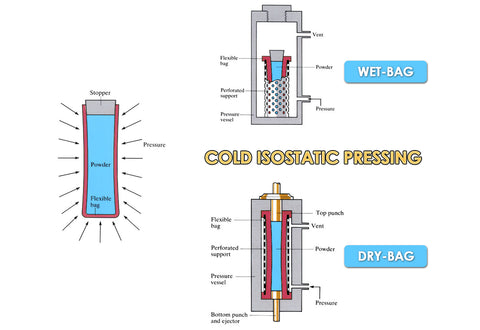
Cold Isostatic Pressing (CIP) is an advanced powder metallurgy manufacturing process that utilizes an incompressible fluid medium to transmit equal pressure simultaneously across all surfaces of a sealed flexible mold. Designed to compact high-purity ceramic powders into near-net shape green compacts, CIP achieves isotropic density distributions unmatched by conventional axial die pressing.
At MIM Supplier, our 15+ years of ceramic engineering experience enables global OEM manufacturers to leverage Cold Isostatic Pressing, Hot Isostatic Pressing (HIP), and Warm Isostatic Pressing (WIP) for high-density, defect-free technical ceramic components. Certified to ISO 9001:2016 and ISO 13485:2015 quality standards, our facility guarantees precise sintering shrinkage control, optimal mechanical integrity, and reliable performance across extreme thermal and electrical environments.
Engineering Insight: Why Choose Isostatic Pressing for Ceramics?
Unlike uniaxial mechanical pressing which creates internal density gradients and localized friction walls, Isostatic Pressing applies Pascal’s principle in a hydraulic fluid environment. This uniform multi-axis compaction eliminates micro-cracks, warpage, and structural porosity prior to high-temperature vacuum sintering.
The Fundamental Working Principle of CIP
The Cold Isostatic Pressing workflow compresses ceramic powders at ambient temperatures under hydraulic pressures ranging from 100 MPa to 400 MPa (14,500 PSI to 58,000 PSI). Powdered raw materials—such as high-purity Alumina (Al₂O₃), Yttria-Stabilized Zirconia (YSZ), Silicon Carbide (SiC), and Silicon Nitride (Si₃N₄)—are homogeneously milled, spray-dried, and encapsulated in flexible elastomeric molds.
Key Advantages of Isostatic Pressing in Advanced Ceramics
Isostatic Pressing Technologies: CIP vs. HIP vs. WIP
Selecting the appropriate isostatic pressing technique depends on the required material density, thermal tolerance, geometry, and post-processing thermal treatment. The technical comparison below outlines our core capability spectrum:
Cold Isostatic Pressing (CIP)
Performed at room temperature (20°C–50°C) with pressures up to 400 MPa. Primary method for forming large, intricate green ceramic compacts with isotropic grain alignment.
Warm Isostatic Pressing (WIP)
Operates at moderate temperatures using heated liquid mediums. Ideal for polymer-bonded ceramics or multi-layer laminate ceramic substrates requiring enhanced binder flow during pressing.
Hot Isostatic Pressing (HIP)
Combines extreme heat (>1500°C) and inert Argon gas pressure (up to 200 MPa) to eliminate micro-porosity, producing fully dense, pore-free structural ceramic parts.
Technical Parameter Comparison Matrix
| Process Metric | Cold Isostatic Pressing (CIP) | Warm Isostatic Pressing (WIP) | Hot Isostatic Pressing (HIP) |
|---|---|---|---|
| Operating Temperature | Ambient (20°C – 50°C) | 100°C – 500°C | 1,000°C – 2,000°C |
| Pressurizing Medium | Water with Anti-Rust Inhibitor / Oil | Heated Water / Thermal Fluid | High-Purity Inert Argon Gas |
| Applied Pressure Range | 100 MPa – 400 MPa | 50 MPa – 200 MPa | 100 MPa – 350 MPa |
| Primary Objective | Green Part Powder Compaction | Laminate Bonding & Moderate Densification | Full Porosity Elimination & Sintering |
| Achieved Relative Density | 60% – 70% (Green State) | 70% – 85% (Green State) | 99.5% – 99.9% (Fully Sintered) |
| Tooling / Mold Type | Elastomeric Polyurethane / Rubber | High-Temp Polymer Flexible Sleeves | Refractory Hermetic Metal / Glass Can |
Wet-Bag vs. Dry-Bag CIP Systems
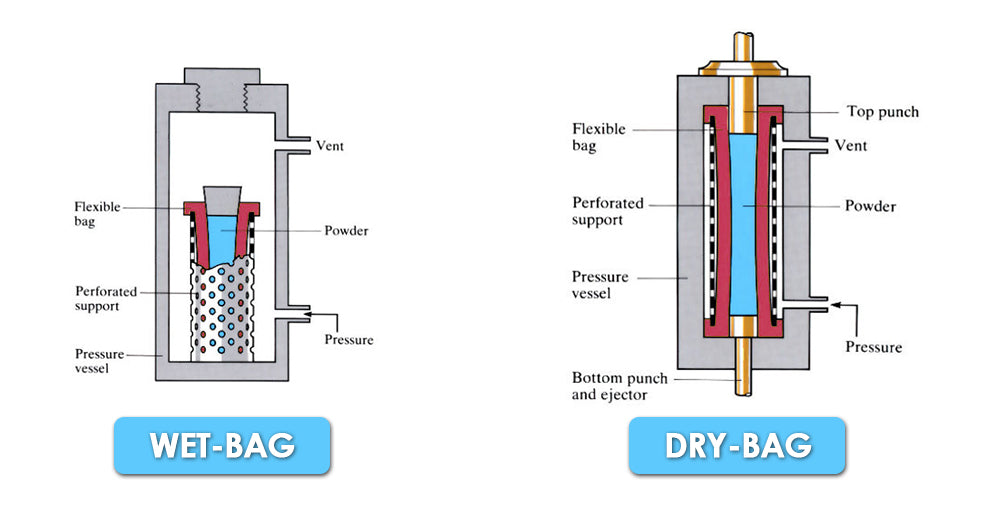
Depending on production volume and part dimensions, our manufacturing line operates two distinct Cold Isostatic Pressing modalities:
1. Wet-Bag CIP (Tooling Versatility): The ceramic powder is pre-sealed inside an independent flexible mold and entirely submerged into the pressurizing liquid chamber. This process offers ultimate design flexibility for large structural parts, prototype development, and complex custom geometries.
2. Dry-Bag CIP (Automated High-Volume Production): The elastomeric membrane is permanently integrated inside the pressure vessel itself. Powder is fed automatically into the vessel sleeve, compressed, and ejected rapidly, making it perfect for mass production of ceramic rods, insulator tubes, and wear nozzles.
Key Industrial Applications for Isostatically Pressed Ceramics
Isostatically pressed technical ceramics are engineered for applications demanding supreme hardness, electrical insulation, chemical corrosion resistance, and thermal endurance:
- Semiconductor Manufacturing: High-purity Alumina (99.8%) ceramic end effectors, wafer chucks, plasma etching chamber rings, and insulator plates.
- Medical Implants & Surgical Tools: Biocompatible Zirconia (Y-TZP) joint prostheses, ceramic dental blocks, laparoscopic surgical tool tips, and electrical scalpel insulators.
- Aerospace & Defense: High-strength Silicon Nitride radomes, turbine blade cores, rocket nozzle liners, and armor ceramic tiles.
- Industrial & Chemical Processing: Heavy-duty ceramic valve balls, seats, mud pump sleeves, wire drawing dies, and extreme wear nozzles.
Strict Quality Control & Metrology Standards
To guarantee zero internal defects and rigorous mechanical performance for international OEM clients, MIM Supplier enforces complete end-to-end quality assurance:
- 100% Ultrasonic & X-Ray NDT Inspection: Verification of zero internal voids, cracks, or density variations prior to final delivery.
- CMM & Optical Profilometer Testing: Precision coordinate measuring machines ensuring strict dimensional compliance (tolerances up to ±0.001mm post-grinding).
- Density & Hardness Verification: Archimedes method density measurement (>99.5%) and Vickers Micro-Hardness (HV) validation.
Ready to Consult Our Ceramic Engineering Experts?
Upload your 2D/3D CAD models to receive a comprehensive Design for Manufacturability (DFM) analysis and an instant competitive quote for your isostatic pressing project.
Send an Inquiry